I was a skeptic on this one for a long time, so if you're rolling your eyes at the phrase "soft skills training in VR," I understand the instinct. Hard skills made obvious sense to me. Teaching someone to weld, to service a turbine, to run a hazardous procedure, of course you'd want them rehearsing in a safe, repeatable environment. But teaching empathy in a headset? Practicing a difficult conversation with a cartoon? That sounded like a stretch, and for a while I said so.
I've changed my mind, but not all the way, and the nuance is the whole point. So here's the honest version: what VR genuinely does for soft skills, what it doesn't, and how to tell whether a given program is the real thing or a gimmick.
Why I doubted it, and why the doubt was half right
My objection was simple. Soft skills are about reading a real human being. A flicker of irritation, a pause that means someone's about to push back, the thing they don't say. How could a piece of software possibly stand in for that?
That objection still holds for the bad version of this training, so don't let anyone wave it away. If the "conversation" is you picking option A, B, or C from a menu while a stiff avatar reads canned responses, you're right to be unimpressed. That's a personality quiz wearing a headset. It teaches you to game a script, not to handle a person, and there's plenty of it being sold.
So the skepticism is healthy. The mistake is assuming that's all VR soft-skills training can be.
What changed: the conversation got real
The thing that turned me around was talking to a virtual human that genuinely talked back.
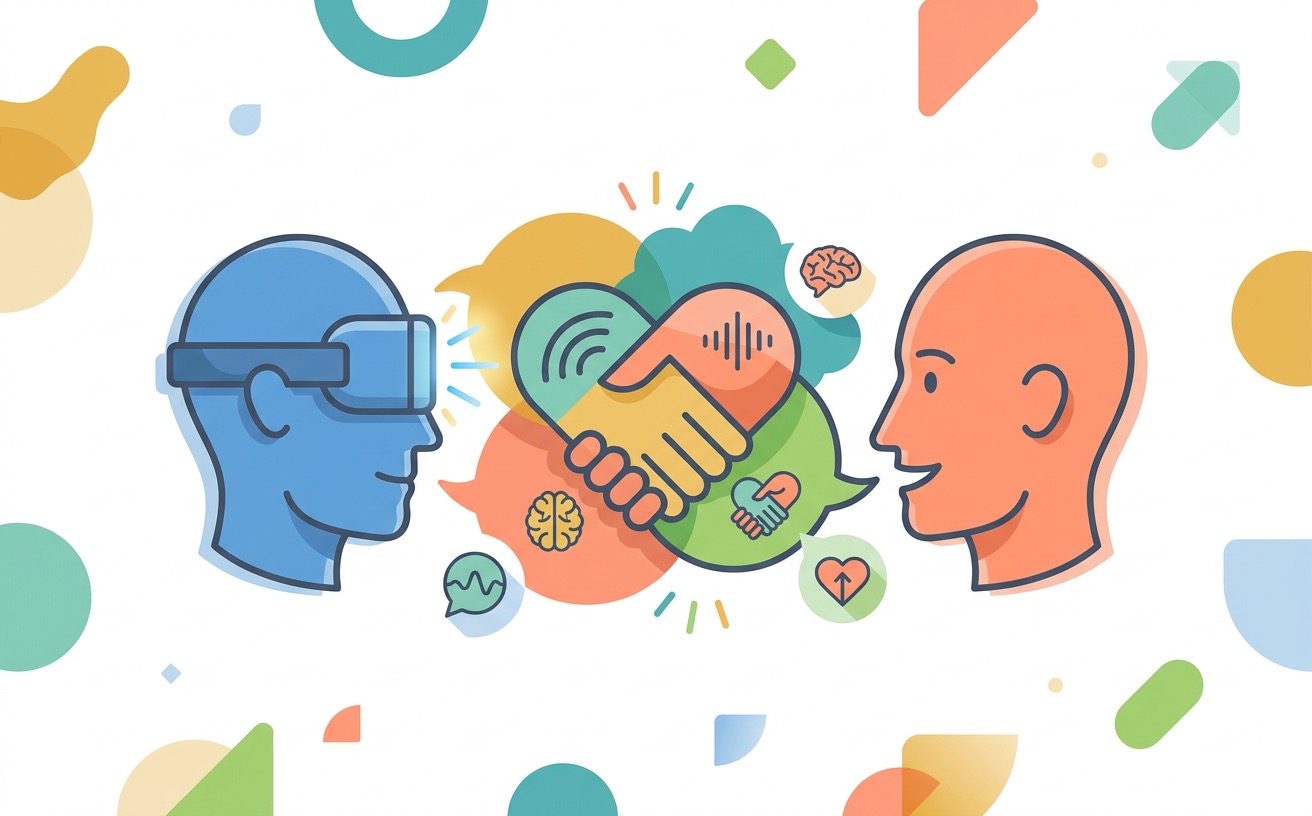
When you put a real language model behind the character, the menu disappears. You don't select a response. You say something, out loud, in your own words, and the character responds to what you actually said. Push too hard and you can watch them get defensive. Soften your approach and you can feel the conversation turn. It's unscripted, and that's the entire difference. You're no longer rehearsing lines. You're practicing the skill itself, which is the thing the old version could never do.
That's why the heavyweight consulting firms have leaned into this for leadership and communication training. It finally crossed the line from theater into practice, and once you've felt that line get crossed it's hard to go back to clicking buttons.
What VR does that role-play and e-learning can't
Even granting that the conversation is good, you might fairly ask: why not just role-play with a colleague? People did that for decades.
Three reasons VR wins, and they're practical, not philosophical.
First, it removes the embarrassment. Practicing a hard conversation in front of your actual boss or peers is excruciating, and the embarrassment makes people clam up and perform rather than learn. A private headset has no audience. People take real risks, fumble, and try again, because nobody's watching them be bad at it yet.
Second, it's consistent and repeatable. Role-play depends entirely on the skill and mood of your partner, so everyone gets a different experience and you can't compare results. A virtual scenario is the same challenge every time, which means you can actually measure whether someone improved.
Third, and this is the one people underrate, you can do it together when it counts. Good platforms let a group share the same virtual space, so a facilitator can run a live session with people in different cities, debrief in the moment, and have everyone learn from one person's attempt. That blend of private practice and shared coaching is something neither a Zoom call nor a conference room quite manages.
Where it still falls short, and you should say so
I promised honesty, so here are the limits I'd put in writing.
VR doesn't replace real human coaching, it sharpens it. The headset is the gym where you build the reps; a good coach is still what turns reps into judgment. Treat it as a replacement for human development and you'll be disappointed.
The avatars also aren't perfect actors yet. They're good enough to practice against, genuinely, but they don't yet carry the full weight of real human micro-expression, and anyone who tells you otherwise is selling. The gap is closing fast. It isn't closed.
And it's wasted on the wrong content. If your "soft skill" is really memorizing a compliance script, you don't need an unscripted virtual human to recite it back at you. Save VR for the skills that genuinely live or die on how you handle another person in the moment.
So, can you? Yes, with your eyes open
Here's where I landed after starting out a doubter. Yes, you can genuinely train soft skills in VR, as long as the conversation is unscripted, the scenarios match real situations your people actually face, and you treat it as practice that complements human coaching rather than replacing it. Get those three right and it works in a way I honestly didn't believe a few years ago.
Get them wrong, and the skeptics in your audience will be proven correct, loudly, and you'll have a very expensive personality quiz on your hands.
My advice is to test it the hard way. Put on the headset, pick the most difficult conversation in your world, and try to throw the virtual human something it can't handle. If it holds up, you've got your answer. If you want to run that test against something we've built, we'll happily hand you the headset and get out of your way. Talk with an expert.
Elena Voss is a learning experience designer at Sketchbox focused on AI-driven and behavioral training.